Germany Urges Stunning US-Iran Talks, Minesweep Hormuz


Germany’s push for US-Iran talks over the Strait of Hormuz signals how seriously European capitals are treating the risk of a wider regional confrontation, but it also exposes a familiar problem: diplomacy is being urged precisely because deterrence is getting shakier.
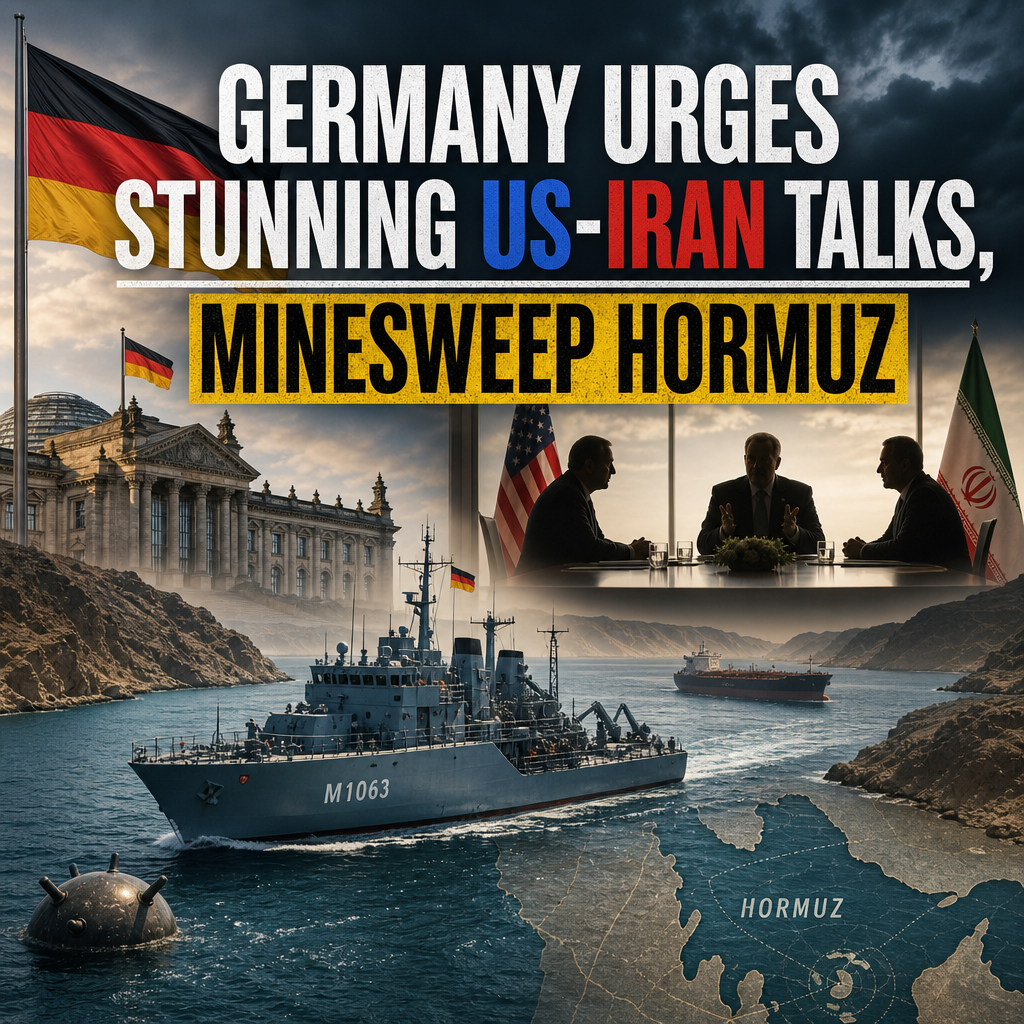
The German government’s reported willingness to help with minesweeping in the Strait of Hormuz, alongside calls for negotiations between Washington and Tehran, reflects a blend of caution and realism. It is a practical proposal for a chokepoint that handles a large share of global oil traffic, but it is also a political message: Europe wants de-escalation before a maritime crisis turns into a broader military one.



Germany’s message: reduce the risk before it spreads
At the heart of Germany’s stance is a simple calculation. The Strait of Hormuz is one of the world’s most sensitive shipping lanes, and any disruption there can quickly affect energy prices, insurance costs, and military deployments far beyond the Gulf. By offering support for minesweeping, Berlin is signaling that it sees maritime security as a shared international responsibility rather than a problem to be left to regional powers alone.
The diplomatic side of the message matters just as much. Germany’s call for US-Iran negotiations suggests concern that the current cycle of pressure, retaliation, and threat-making could become self-reinforcing. In that sense, the offer is not just about clearing sea lanes; it is about creating enough stability for talks to happen at all.




That approach has some appeal:
– It gives European governments a role other than passive observer.
– It keeps the focus on preventing disruption to global trade.
– It avoids framing the issue purely as a military standoff.
Still, the plan is not without risk. Any European naval involvement in a highly contested waterway can be read through a political lens, especially if either side sees it as aligned with US strategy. That makes the distinction between “security assistance” and “pressure” harder to maintain.
Iran, the US, and the problem of trust
The deeper obstacle is that neither Washington nor Tehran seems to trust the other’s intentions. From the US perspective, Iran’s regional posture, missile capabilities, and influence over allied groups have long been viewed as sources of instability. From Iran’s perspective, American sanctions and military signaling are often presented as proof that diplomacy is simply a pause between pressures rather than a genuine path to compromise.
This is why Germany’s intervention is interesting but limited. It can encourage contact, but it cannot create trust where years of confrontation have eroded it. Even if both sides agreed to talks, the hardest questions would remain unresolved: sanctions relief, nuclear constraints, regional security, and the rules of maritime conduct.
There is also a broader strategic question. If the Strait of Hormuz becomes a recurring pressure point, then minesweeping and naval escorts may only address the symptom, not the cause. The underlying issue is whether the Gulf can move from threat management to a more stable security framework. So far, that seems distant.
Why the maritime angle matters
The minesweeping offer is symbolically powerful because it connects diplomacy to immediate practical risk. If ships are threatened, delayed, or damaged, the consequences are not abstract. They are felt in supply chains, fuel markets, and shipping insurance almost immediately.
That said, sea-lane security can cut both ways. A stronger foreign naval presence may reassure commercial operators, but it can also raise the possibility of miscalculation if military vessels from different countries operate in close proximity. In a tense environment, even routine maneuvers can become politically charged.
Different readings of the same move
The reactions to Germany’s proposal likely depend on where observers stand.
Some see it as a sensible European effort to prevent escalation. In that reading, Germany is doing what middle powers often do best: lowering the temperature, keeping channels open, and avoiding a binary choice between confrontation and inaction.
Others may view it as too cautious, arguing that diplomacy without leverage rarely changes behavior. From that perspective, minesweeping is useful only if it is paired with clear consequences for any attacks on shipping and a coordinated strategy to deter further escalation.
A third view, often heard from more skeptical commentators, is that Western governments are once again trying to manage a crisis they helped create through sanctions, military presence, and inconsistent diplomacy. That criticism does not necessarily solve the immediate problem, but it does capture a real frustration: repeated crises in the Gulf often produce short-term fixes instead of durable agreements.
A reasonable conclusion: useful, but not enough
Germany’s proposal is best understood as a pragmatic attempt to contain danger, not a breakthrough. It recognizes that the Strait of Hormuz cannot be treated as an afterthought and that a shooting or shipping incident there could have consequences well beyond the region.
At the same time, minesweeping alone will not resolve the larger confrontation between the US and Iran. Nor will it substitute for the difficult political work of rebuilding communication, setting boundaries, and making restraint credible on both sides.
The most balanced reading is that Germany is trying to buy time for diplomacy. That is worthwhile. But the window for useful diplomacy tends to shrink quickly once military posture hardens and maritime incidents begin to dominate the news. If the goal is truly to avoid a wider crisis, then the real test will not be whether sea lanes can be protected for a few weeks, but whether the parties can find enough political space to talk before the next confrontation closes it.